
Course Overview
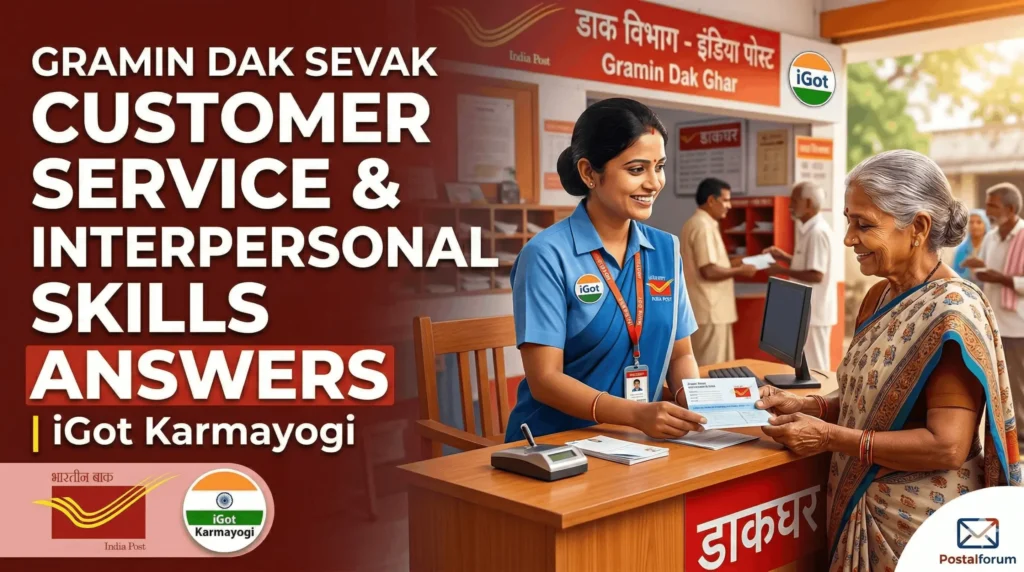
As the primary point of contact for India Post in rural areas, Gramin Dak Sevaks (GDS) play a crucial role in shaping public perception. This iGOT Karmayogi training module provides practical guidance to help you excel in this vital role.
The curriculum is designed to build confidence in customer interactions, focusing on clear and respectful communication, active listening, and empathy. Through relatable examples and actionable tips, learners are equipped to apply best practices in their daily work—ensuring a positive, consistent customer experience and establishing themselves as trusted community partners.
Key Learning Outcomes
By completing this module, you will be able to:
- Analyze the role and responsibilities of a GDS in delivering citizen-centric services.
- Apply effective communication and interpersonal techniques to interact clearly and respectfully with rural customers.
- Develop strong customer relationships based on trust, reliability, and professional conduct.
- Resolve common service challenges and customer complaints with patience and confidence.
- Implement best practices for service excellence to create a positive customer experience in daily operations.
Course Answers
1. A villager cannot understand English while asking about a savings account. How should the GDS respond?
- Use local language and gestures to make the process clear
- Switch fully to local language but shorten the explanation to save time
- Hand over an English leaflet and ask them to study it later
- Request they come back with a family member who knows English
Correct Answer: Use local language and gestures to make the process clear
2. A customer nods but still looks unsure. What should the GDS do?
- Assume the nod means they understood
- End the conversation politely and move on
- Ask them to repeat the main points in their own words
- Suggest they consult a family member later
Correct Answer: Ask them to repeat the main points in their own words
3. Communication is most effective when:
- The GDS uses correct technical terms
- Both sides understand and confirm the message
- Only the GDS speaks and the customer listens silently
- Explanations are kept very short to save time
Correct Answer: Both sides understand and confirm the message
4. A customer interrupts frequently while GDS is explaining a service. Best approach :
- Stop the explanation and let them speak fully first
- Politely acknowledge their point, then complete the explanation
- Ignore interruptions and continue without pause
- Ask them not to interrupt until the end of the explanation
Correct Answer: Politely acknowledge their point, then complete the explanation
5. A villager asks about a scheme the GDS is not sure about. What is the best response?
- Give a rough guess to avoid appearing uninformed
- Avoid answering and change the topic
- Direct the customer to visit a bigger post office
- Admit not knowing fully but promise to confirm and update
Correct Answer: Admit not knowing fully but promise to confirm and update
6. Which situation shows good customer service?
- Ignoring minor doubts to keep the line moving
- Finishing transactions quickly with little interaction
- Serving known people faster than others
- Giving every customer respect and patience during rush hours
Correct Answer: Giving every customer respect and patience during rush hours
7. Which of these makes rules easier for villagers to understand?
- Reading rules directly from the rulebook
- Asking them to get the details from the Panchayat office
- Explaining them through examples from farming or daily life
- Repeating the same line quickly multiple times
Correct Answer: Explaining them through examples from farming or daily life
8. Which behaviour is most likely from a satisfied customer?
- Recommending India Post services to others
- Avoiding the post office in future
- Complaining about small issues unnecessarily
- Asking only family members to use services
Correct Answer: Recommending India Post services to others
9. Communication usually fails when :
- Customers feel ignored or their doubts are dismissed
- Messages are explained using relatable examples
- Both sides check for clarity before ending
- The GDS actively listens and allows questions
Correct Answer: Customers feel ignored or their doubts are dismissed
10. A customer complains angrily about late delivery. The GDS should :
- Point out that delays are common and unavoidable
- Stay calm, listen, explain the reason, and assure follow-up
- Remain silent to avoid escalation
- Say the delay is not under GDS’s control
Correct Answer: Stay calm, listen, explain the reason, and assure follow-up
11. Effective communication in a rural post office mainly means :
- Information given only when asked by customer
- Very short instructions without explanation
- Formal words in official language
- Respectful, clear conversation in local language
Correct Answer: Respectful, clear conversation in local language
12. A customer looks frustrated because the explanation is too long. What should the GDS do?
- Continue with full detail to cover every rule
- Stop midway and ask them to read the notice board
- Tell them to come later when they have more time
- Shorten the explanation but keep the key points clear
Correct Answer: Shorten the explanation but keep the key points clear
13. Interpersonal skills in post office work mostly mean :
- Giving strict instructions to others
- Using only formal words and tone
- Keeping silent to avoid mistakes
- Cooperation, empathy, and respectful listening
Correct Answer: Cooperation, empathy, and respectful listening
14. A pensioner complains about delayed payment. The GDS should :
- Avoid discussion since delay is not their fault
- Ask the customer to come another day
- Suggest filing a complaint to the head office
- Listen and explain the reason clearly, then reassure
Correct Answer: Listen and explain the reason clearly, then reassure
15. Trust with customers is built mainly through :
- Avoiding details to prevent confusion
- Making promises that may not always be kept
- Clear and honest communication of rules and services
- Staying very strict and less approachable
Correct Answer: Clear and honest communication of rules and services
16. An elderly customer drops their passbook. The GDS should :
- Pick it up respectfully and return it
- Tell them to be more careful in future
- Wait for someone else to help
- Laugh lightly to ease the moment
Correct Answer: Pick it up respectfully and return it
17. Which option best represents ‘Customer First’ in India Post?
- Avoiding detailed interaction to finish faster
- Serving only when customers follow rules exactly
- Treating every customer fairly with patience and transparency
- Giving priority to VIP or influential people
Correct Answer: Treating every customer fairly with patience and transparency
18. Which action shows poor customer service?
- Listening carefully before replying
- Explaining a scheme with simple examples
- Guiding a confused customer patiently
- Ignoring questions to finish work quickly
Correct Answer: Ignoring questions to finish work quickly
19. A customer is struggling with a form. The best approach is :
- Guide step by step so they can fill it themselves
- Tell them to come back with a filled form later
- Fill it completely for them to save time
- Ask another customer to help them
Correct Answer: Guide step by step so they can fill it themselves
20. When a supervisor issues new instructions, GDS should :
- Listen attentively and follow them
- Question the instructions immediately in public
- Stick to old methods for convenience
- Partially follow depending on the situation
Correct Answer: Listen attentively and follow them
Join Our Postal Forum Group
Get the latest updates, circulars, and DoP orders right at your fingertips. Join our 7,000+ strong Postal Community today!